
From Mirage to Hard Rock Las Vegas: How the Guitar Tower Is Changing the Strip
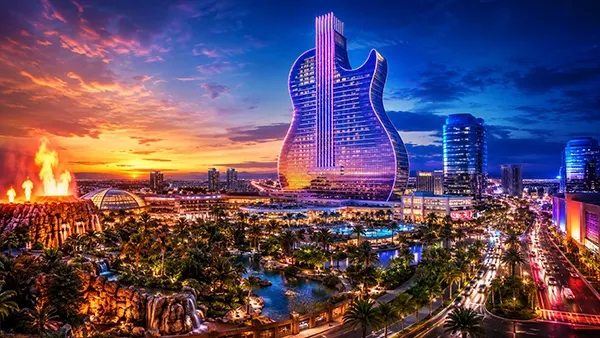
Few addresses illustrate the constant reinvention of Las Vegas as clearly as 3400 Las Vegas Boulevard South. The Mirage opened there in 1989 and helped establish the large integrated resort as the dominant model for the modern Strip. More than three decades later, the same site is undergoing another major architectural reset. Hard Rock Las Vegas is replacing the Mirage identity with a resort centred on a nearly 700-foot guitar-shaped hotel tower. By 2026, this is no longer simply a rendering of a future project: the tower has reached its full structural height, while work continues towards an opening targeted for the fourth quarter of 2027. The change therefore offers a useful way to understand how Las Vegas architecture has moved from immersive themed environments towards buildings that function as landmarks in their own right.
The Mirage Created a New Model for the Las Vegas Strip
When The Mirage opened on 22 November 1989, its scale immediately distinguished it from the casino hotels that had defined earlier periods of Las Vegas development. The resort cost approximately $630 million, an exceptional figure for the time, and became widely recognised as the first of the modern Strip mega-resorts. Architect Joel Bergman, Paul Steelman and other members of the design team worked with Steve Wynn on a property that combined a large hotel, casino, restaurants, entertainment venues and elaborate public attractions within one destination. Its Y-shaped hotel tower also provided an efficient arrangement of rooms while giving a large proportion of guests views beyond the property.
The architecture was only one part of the Mirage identity. Its frontage along Las Vegas Boulevard was designed as a tropical landscape containing water, dense planting, waterfalls and the artificial volcano that became the resort’s most recognisable feature. Instead of placing the main building directly against the pavement, the designers created distance between the boulevard and the hotel. That space became part of the entertainment. People did not need to book a room or enter the casino to understand the theme because the lagoon and volcano communicated it from the street.
This approach influenced much of the Strip development that followed during the 1990s. New resorts increasingly competed through architecture, landscaping and attractions as well as casino floors. Treasure Island introduced its pirate setting, Luxor used a pyramid and sphinx, while later developments such as Bellagio placed major public spectacles along Las Vegas Boulevard. The Mirage demonstrated that a resort could attract visitors by creating a recognisable environment around the hotel rather than treating the accommodation tower as the property’s only architectural statement.
Why the Mirage Was More Than a Casino Hotel
The Mirage also helped change expectations about what a Las Vegas resort should contain. Its tropical atrium, aquarium, animal attractions and major entertainment productions encouraged visitors to spend time on the property for reasons unrelated to gambling. The volcano was particularly important because it turned part of the resort into free public entertainment visible from the pavement. That idea became a familiar feature of the Strip: architecture and entertainment could work together to attract pedestrians before they decided whether to enter a building.
The physical arrangement supported this broader resort concept. The hotel tower sat behind the landscaped frontage rather than dominating the pavement, allowing the tropical setting to act as a transition between Las Vegas Boulevard and the interior. From a visitor’s perspective, the journey towards the casino was deliberately staged. Water, planting and the volcano created an artificial environment before guests reached the main indoor spaces. The design was theatrical, but the theatre was created largely through landscape rather than through the outline of the hotel itself.
The Mirage finally closed on 17 July 2024 after Hard Rock International had acquired its operating business from MGM Resorts International in a transaction valued at nearly $1.1 billion. Closing the property allowed a much larger redevelopment to begin. The original Mirage identity is being removed, but the redevelopment is not a complete clearance of everything that previously occupied the site. Existing hotel structures are being renovated and incorporated into Hard Rock Las Vegas, creating a combination of extensive reuse and major new construction.
The Guitar Tower Turns the Hotel Itself into the Main Attraction
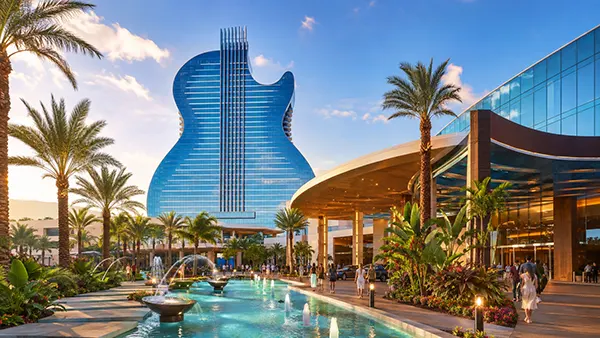
The most visible part of the redevelopment is the Guitar Hotel. The tower rises nearly 700 feet above the central Strip and is formed to resemble two back-to-back electric guitars. It contains roughly 600 hotel rooms and stands significantly higher than the former Mirage hotel tower. On 1 May 2026, the project reached a major construction milestone when the final primary structural beam was placed at the top of the building. The event confirmed that the basic shape now visible above Las Vegas Boulevard represents the actual scale of the future hotel rather than an approximate concept shown only in promotional images.
Its form creates a very different relationship between architecture and branding. The Mirage required its volcano, lagoon, landscaping and signage to establish a recognisable identity from the street. Hard Rock can use the outline of the building itself. Even without a large name fixed across the upper floors, the guitar shape identifies the resort from a distance. In architectural terms, the hotel is therefore doing work that previously belonged to separate attractions. The structure is accommodation, skyline marker and brand symbol at the same time.
The visual contrast with the Mirage is reinforced by changes to the retained buildings. The Mirage was known for its warm gold-coloured glazing, while the redevelopment is replacing that appearance with blue-tinted glass intended to coordinate with the new Guitar Hotel. This means the project is not simply placing an unusual tower beside an older resort. The surrounding buildings are also being visually altered so that the property reads as a single Hard Rock complex rather than a new addition attached to an obviously preserved Mirage.
How the New Design Changes the Las Vegas Boulevard Frontage
One of the largest changes occurs where the Mirage volcano and lagoon once stood. That area gave the old resort a relatively open, landscaped edge along the Strip. The Guitar Hotel occupies the part of the property associated with that former attraction, replacing a low horizontal spectacle with a tall permanent landmark. The difference is significant for pedestrians. The Mirage frontage was experienced mainly at close range, particularly when crowds gathered around the lagoon for an eruption. The guitar can be recognised from much farther away and becomes part of the broader skyline before a visitor reaches the site.
This represents a shift in the way spectacle is incorporated into resort architecture. A volcano produces an event at specific times; a distinctive tower remains visible throughout the day. Lighting can change its night-time appearance, but the building does not depend on a scheduled show to explain what it represents. The result is a more direct form of visual communication in an area where hotels, digital signs, retail façades and entertainment venues already compete heavily for attention.
The change also makes the central Strip more vertically assertive. Nearby properties such as Caesars Palace and The Venetian rely on recognisable architectural themes spread across several buildings, façades and public spaces. The guitar takes another approach by concentrating much of the identity into one extremely clear silhouette. That does not make it more important than its neighbours, but it changes the visual balance around this part of Las Vegas Boulevard. A building designed as a giant object will naturally become a reference point in views along the street and from surrounding hotels.
Hard Rock Las Vegas Reflects a Different Era of Resort Architecture
The redevelopment shows how the priorities of Las Vegas resort design have changed since the Mirage opened. In the late 1980s and 1990s, many properties created imaginary destinations through detailed themes. Visitors could encounter tropical islands, medieval castles, ancient Egypt, New York streets or European landmarks within a few kilometres of Las Vegas Boulevard. Hard Rock’s guitar is also theatrical, but it does not attempt to reproduce another city or historical period. Its identity is based on a single contemporary object enlarged to the scale of a skyscraper.
At the same time, the project remains a large integrated resort rather than simply an unusual hotel. Current plans call for more than 3,700 rooms across the completed property, approximately 175,000 square feet of gaming space and more than 200,000 square feet devoted to meetings and events. Restaurants, lounges, retail areas, pools and entertainment venues form part of the redevelopment as well. In that respect, Hard Rock is continuing the model that the Mirage helped establish: the property is expected to operate as a self-contained destination offering accommodation and multiple forms of leisure under one resort identity.
The way the site is being rebuilt is also notable. Some highly recognisable Mirage elements, including the volcano, have disappeared, while useful portions of the earlier resort are being retained and extensively redesigned. The result sits between preservation and complete replacement. Visitors who knew the Mirage may still recognise the general position and massing of parts of the original hotel complex, but the colours, frontage and dominant skyline feature will communicate a different property. This approach allows Hard Rock to use parts of an established resort while changing the feature most likely to define the site for the next generation of visitors.
From Themed Landscape to Skyline Identity
The contrast between the two resorts is therefore more complicated than a simple replacement of an old building by a new one. The Mirage was revolutionary because it treated the whole property as an experience. Its tower, tropical environment, volcano and entertainment programme worked together to create an identity. Hard Rock applies a similar principle using a different visual language. Instead of surrounding a comparatively conventional hotel tower with an extraordinary environment, it turns the hotel tower into the extraordinary object.
There is also a practical reason why this approach suits contemporary Las Vegas. The Strip is already densely developed, and visitors see its buildings through more than a pedestrian walk along Las Vegas Boulevard. Hotel-room views, taxis, airport approaches, social media photographs and distant skyline views all contribute to the way a resort is recognised. A guitar several hundred feet high can communicate its identity from many of those positions. The architecture effectively becomes a permanent visual marker rather than relying mainly on signage or a street-level attraction.
Hard Rock Las Vegas is currently targeted to open in the fourth quarter of 2027, so the finished relationship between the tower, its lighting, surrounding buildings and pedestrian areas will only become fully clear after construction is complete. By August 2026, however, the basic architectural change is already visible. The Mirage helped transform Las Vegas by showing how a resort could become an immersive destination. The Guitar Hotel represents another stage in the same continuing competition for recognition: instead of hiding a fantasy behind landscaping and a dramatic entrance, the new resort places its symbol directly into the skyline.